





Staircase ceiling light: making the climb safer and more beautiful

Key takeaways:
- A staircase ceiling light is a light fixture mounted flush to the ceiling of the stairwell or landing, lighting every step without getting in the way.
- Choose it based on the layout of the staircase: a compact, diffusing model under a low ceiling, a wider ceiling light in a tall or winding stairwell.
- Installation and wiring should be entrusted to a qualified electrician, and a two-way switch, at the top and the bottom, lets you turn the light on before stepping onto the stairs.
A staircase ceiling light is a light fixture mounted flush to the ceiling, in the stairwell or on the landing, whose light falls onto the steps to make both climbing and descending safer. A central passageway between floors, often placed between an entryway and a hallway, sometimes open to a living room or a dining room, the staircase is nevertheless frequently overlooked, even though good lighting prevents accidents and makes getting around easier.
In a hallway as in a stairwell, the ceiling light is a reliable and constant source of light, just like a hallway ceiling light in the neighboring passage. Well placed, it makes every step visible, even in a low or dimly lit space, and meets a simple but essential need: providing safe lighting, day after day.
It differs from a chandelier or a pendant light in its ability to fit into spaces of varying heights: in a stairwell, or in the passage leading to the bedrooms, it gives off a soft light without obstructing the way. Unlike a floor lamp or a hanging chandelier, it reduces visual and physical obstacles. One of our ceiling lights is therefore ideal when the ceiling height is limited, or when you want to avoid an overly imposing effect, in a villa as in an apartment.
Styles and materials

The style of the ceiling light plays a full part in the interior decor. Extra-flat LED ceiling lights, glass globes, metal models or short chandeliers: the shapes are many, and our selection mainly brings together modern, design-led models, in metal, glass or acrylic, in black, white or gold finishes.
From industrial spirit to contemporary style
An industrial ceiling light in black metal, or a vintage brass ceiling light (which develops a patina over time if it is not varnished), fits perfectly into a workshop-style architecture or an Art Deco setting. Wood or rattan models create a warm and natural atmosphere, welcome when the staircase leads to a bedroom or a living space. Depending on the product pages, you will find them among our wooden ceiling lights.
An industrial metal cage ceiling light, diamond-shaped, or a small cage fixture that shows off its bulb, brings a graphic and original effect. The contemporary style, for its part, relies on an elegant, clean design, most often in white, with a cooler white light.
Finishes, colors and shapes
Finishes play an important role in the overall atmosphere. A white ceiling light blends into the ceiling and gives off a more neutral light, while a black ceiling light adds contrast.
Some light fixtures offer a form of personalization through their round or star-shaped silhouettes, or through vintage-inspired materials. The choice is made according to the furniture, the table or the elements already present in the neighboring room, to achieve a cohesive whole. In a large stairwell, a ceiling light can also be complemented by wall sconces or step spotlights.
Choosing the right ceiling light
Choosing according to the layout of the space
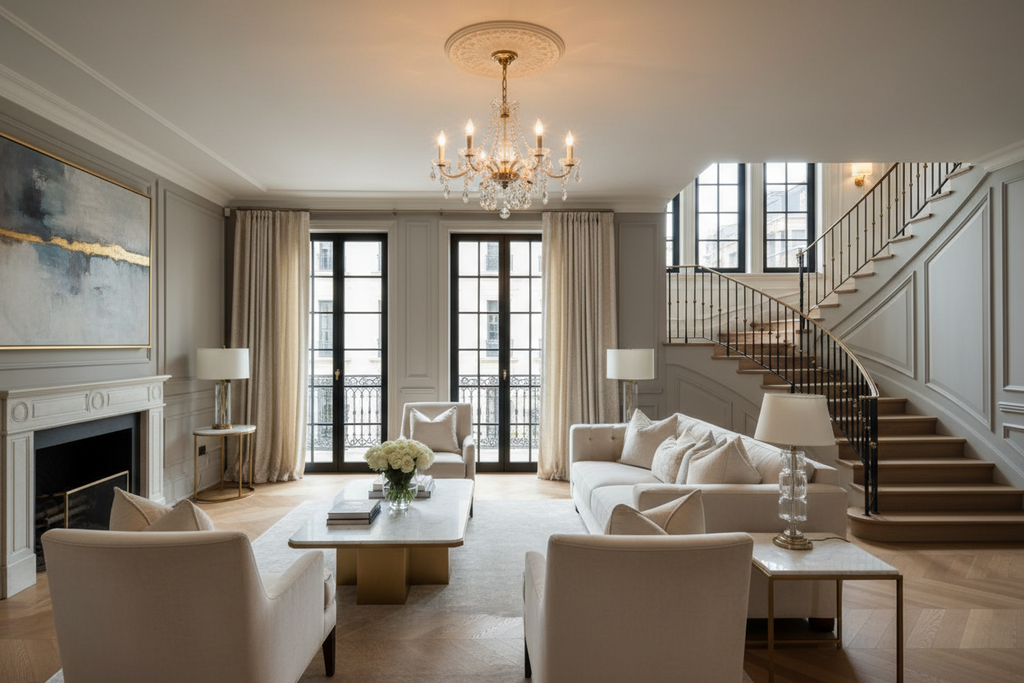
The layout of the stairwell has a decisive influence on the choice of ceiling light. In a straight or winding staircase, a round LED ceiling light, or a white ceiling light mounted flat against the ceiling, provides even diffusion along the whole length of the flight.
For a more complex staircase or under a high ceiling, you can consider a staircase chandelier or a modern chandelier, provided it is properly adjustable. The size, height and length of the fixture must be taken into account to achieve sufficient brightness, whereas in a recessed or narrow space, a discreet model is better, one that avoids any visual discomfort.
In a hallway, an open kitchen or a living-dining room opening onto the staircase, the ceiling light becomes a transitional element, creating a cohesive atmosphere between the kitchen, the living area, the bedroom or the office. A well-chosen hallway and staircase light fixture thus serves several purposes at once. It can be combined with a staircase wall sconce or with indirect lighting, to strengthen the desired effect.
| Layout | Recommended ceiling light | Advice |
|---|---|---|
| Straight staircase, low ceiling | Compact, flat, diffusing model | Light the whole flight, with no cast shadows |
| Winding or narrow staircase | Discreet model with wide diffusion | Add a wall sconce in the turn if needed |
| Tall stairwell or large volume | Large or multi-light ceiling light | Size the fixture to the height |
| Landing open to a living space | Ceiling light matching the style of the living room | Keep the same light tone |
Choosing according to technology and performance
Integrated LED technology is now the most widely used for staircase lighting. A modern LED ceiling light offers high energy efficiency and low consumption, a source of long-term savings. White light, neutral (around 4000 K) or cool, improves visibility, whereas a warm white, from 2700 to 3000 K, promotes a softer atmosphere.
Some ceiling lights include a detector or an automatic detection system, which the product page then specifies. This function is ideal in a stairwell or a hallway that you often use with your hands full, since the lamp only turns on when needed, which limits consumption.
Other options, such as the variable intensity of a dimmable ceiling light or the adjustable height of a hanging model, adapt the brightness to your needs. On a dimmer, check that the LED source is marked "dimmable". It is also possible to use a standard or smart switch, for more comfort.
Specifics of the staircase
On a staircase, the aim is to light all the steps without cast shadows or glare. Provide a switch at the top and another at the bottom (a two-way switch), or a presence detector, so that you never step onto the stairs in the dark.
Since you look up when climbing, an opal diffuser is more pleasant than a bare bulb. The base and maximum wattage accepted by the fixture are indicated on each product page.
Installation and maintenance

Installing and securing the ceiling light
Installing a ceiling light on a staircase requires following certain technical steps, which is why installation and wiring should be entrusted to a qualified electrician. They check the voltage, the electrical connection and the presence of a ground conductor, then securely fasten the ceiling light to the ceiling using a suitable box. This step, essential to avoid any electrical problem, also takes into account the height and size of the fixture, for optimal light diffusion.
In some cases, recessed lighting is added as a complement, for example a few recessed spotlights, to play with volumes and create indirect lighting. This solution also makes it possible to add a light strip along the wall or the steps, and it is particularly effective in a low or narrow staircase. A properly installed ceiling light eliminates shadow areas and improves everyday safety.
Standards and safety
Before ordering, check that the product matches the intended use and the rules in force. A light fixture intended for a wet room must meet specific requirements: the NF C 15-100 standard defines safety zones there, and a bathroom ceiling light has an IP rating of at least IP44. Near the outdoors, only a model designed for that use is suitable, with its IP rating shown on the product page.
Safety is an essential criterion, especially in a passageway as busy as a staircase. Poorly installed lighting can become a source of accidents, so it is recommended to examine every technical aspect before purchase.
Maintenance
Maintenance remains simple: dust the ceiling light with a soft cloth, with the fixture switched off and cooled, without any abrasive product. A glass or acrylic diffuser is cleaned with a barely damp microfiber cloth, without wetting the electrical parts.
Because the fixture hangs over the steps, reaching it requires stable equipment, designed for staircases. An LED source, which lasts much longer than a conventional bulb, fortunately means fewer interventions.
Trends and modern uses of the staircase ceiling light
Today, the ceiling light is no longer limited to a simple function: it plays a full part in the interior architecture and modern design of the home. In a villa or a large space, a chandelier or a staircase pendant light can become a focal point. The models offer a wide variety of styles, from the vintage ceiling light to the cleanest contemporary design, and this diversity makes it possible to find a solution suited to every room.
Indirect lighting is increasingly used to create a soft and pleasant atmosphere. Playing with light turns an often overlooked space into a decorative feature in its own right. A well-chosen ceiling light thus showcases the staircase in a subtle and elegant way, a perfect approach for those who want to combine aesthetics and functionality.
Where to buy a ceiling light?
Lustria, the online reference for light fixtures, is aimed at those looking for reliable and attractive lighting solutions. Each product page states the characteristics of the fixture and its price, and ordering is simple from the cart.
Our advice pages help you choose the ideal light fixture, whether it is a modern LED ceiling light, a pendant light or a wall sconce for the bedroom. The online shop lets you compare, check and adjust your choice in a few clicks, a real asset when furnishing your home. You can also browse all of our staircase light fixtures.
Final word
Choosing a ceiling light for a staircase is an essential step in bringing together safety, comfort and aesthetics. This lighting usefully connects the rooms of the house, from the living room to the bedroom and from the kitchen to the bathroom, while creating a cohesive atmosphere.
With the solutions offered by Lustria, it becomes easy to choose a high-performing light fixture suited to every need. A good ceiling light improves brightness, reduces consumption and highlights the interior architecture, with elegance and for a long time.
Frequently asked questions about the staircase ceiling light
Here are the answers to the most frequently asked questions about staircase lighting.
Why choose a ceiling light to light a staircase rather than another type of light fixture?
Because it gives off an even light from the ceiling without taking up space. Unlike a pendant light or a floor lamp, it does not get in the way and reduces the risk of accidents in a vertical circulation area.
It also covers all the steps with constant brightness, fits into different decor styles and suits narrow stairwells as well as more open spaces.
Which ceiling light is best for a stairwell with a high ceiling?
A powerful ceiling light or one designed for large volumes: a high-performing LED model with wide diffusion effectively lights the entire height.
The size of the fixture should remain proportionate to the space, to avoid an effect that is too discreet or, on the contrary, too imposing. Some ceiling lights distribute the light in a way suited to vertical volumes, for visual comfort and safety.
How much light is needed to light a staircase safely?
Enough intensity to clearly distinguish each step, without causing glare. Light that is too weak creates dangerous shadow areas, whereas light that is too bright becomes uncomfortable.
The goal is balanced, continuous and well-distributed lighting. LED ceiling lights easily reach this level while keeping consumption under control, which improves safety and comfort in daily movement.
How do you match a staircase ceiling light to the interior decor of the home?
By taking into account the materials, the colors and the overall style of the home. A modern interior goes well with clean lines and understated finishes, whereas a more classic decor allows more elaborate shapes.
Chosen in keeping with the overall atmosphere, the ceiling light becomes a decorative element in its own right. You can also play with the color of the light to reinforce the desired atmosphere.
Should you favor an LED ceiling light to reduce energy consumption on a staircase?
Yes, the LED ceiling light is strongly recommended, because it uses little energy and offers excellent light quality. It significantly reduces the electricity bill compared with older bulbs.
LED also lasts much longer, which limits replacements in an area that is sometimes hard to reach, and it turns on instantly, an advantage in a passageway.
What height and size of ceiling light should you choose for a narrow or winding staircase?
A compact and discreet ceiling light, one that does not visually overload the space. The ceiling height should be measured precisely before selecting the model.
A ceiling light that is too bulky gives a feeling of being closed in, whereas a model that is too small may lack efficiency. The point is to find the right balance between size, power and light diffusion.
Is a ceiling light with a motion detector useful on a staircase?
Yes, because it improves both comfort and safety. The light turns on automatically as soon as someone passes, which is very handy when your hands are full.
This function also avoids unnecessary lighting and is helpful when moving around at night. Check on the product page whether the detector is built in: if not, a qualified electrician can add one to the circuit.
How do you avoid shadow areas on the steps with a staircase ceiling light?
By choosing a ceiling light with wide and uniform diffusion, and by taking care over its position, which plays a key role in how the light is distributed.
Complementary lighting sometimes improves the result. The goal is to light the whole staircase without overly sharp contrasts, because good distribution ensures visibility and reduces the risk of falling.
Can you install a staircase ceiling light yourself, or should you call a professional?
It is better to entrust the installation to a qualified electrician. The connection involves the electrical installation, and working at height above the steps requires suitable equipment.
The professional makes sure the fixture is properly fastened and the wiring is safe, in compliance with standards. This is all the more recommended for complex installations or high ceilings.
Which style of staircase ceiling light creates an atmosphere that is both warm and modern?
A ceiling light with clean lines, paired with warm white light. Materials such as glass, metal or wood bring a contemporary touch while remaining welcoming.
The style is chosen according to the desired atmosphere and the existing decor. A simple but elegant design showcases the space without overloading it, as our warm light ceiling lights show.